
Photography is an art of discovery.
Sometimes you go looking for the photograph.
And sometimes the photograph introduces you to a person.
I was aboard That’s All, Brother, the C-47 that led the main airborne formation toward Normandy on the night of June 5, 1944. There is plenty to photograph inside an airplane like that. The worn metal. The aluminum seating along the walls. The windows. The machinery. The little details that remind you this was not built to be comfortable.
And then there was an empty seat.
Beneath the window and above the seat was a small plaque.
Maj. Raymond S. “Chappie” Hall
Chaplain and Paratrooper Seat
I photographed it.
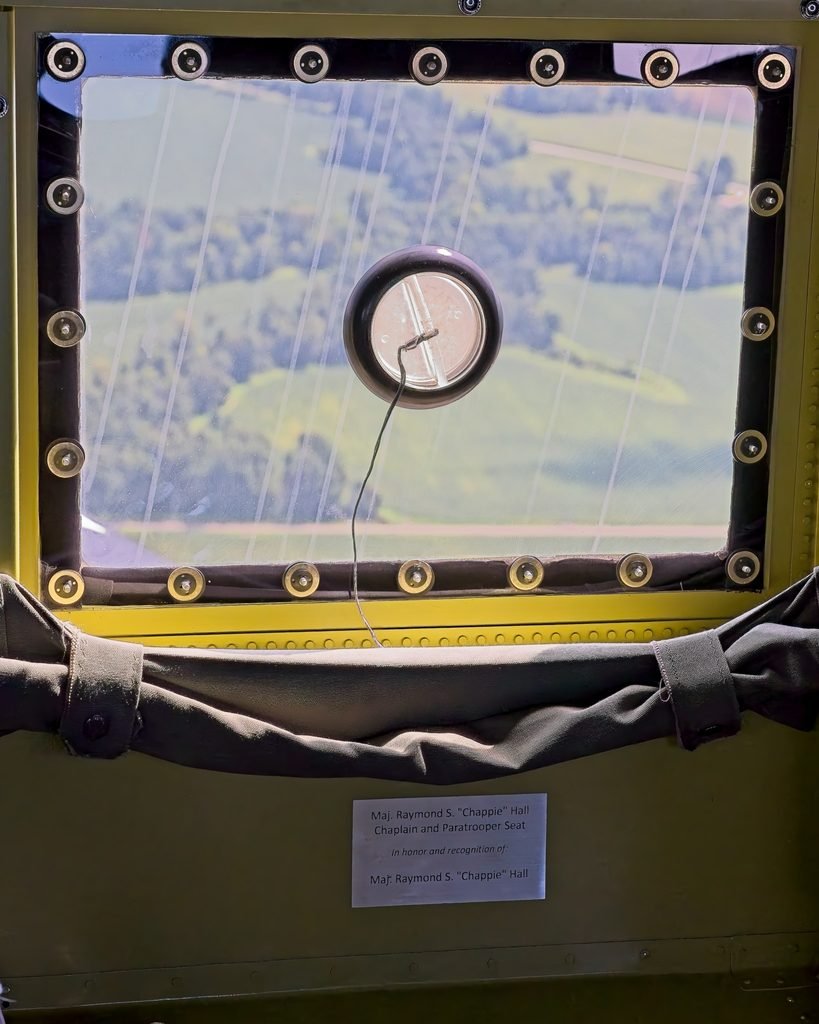
I began wondering about the man who had sat there.
The more I wondered, the more I began to investigate the name above the seat.
His name was Raymond Stewart Hall, although almost everybody seems to have called him Chappie.
He was an Episcopal priest and an Army chaplain. But somewhere along the way, Hall decided that simply being assigned to paratroopers wasn’t enough.
If the men he served were expected to jump out of airplanes, he believed their chaplain ought to understand what that felt like.
So he learned to jump, too.
Contemporary accounts called him the Army’s first “jumping chaplain.”
There is something wonderfully uncomplicated about his reasoning.
Nothing required an Army chaplain to become a paratrooper. Hall apparently believed his ministry required something more.
If his men climbed into the airplane, he climbed into the airplane.
If they wore parachutes, he wore a parachute.
And if someone opened the door over enemy territory and told them it was time to go, Chappie Hall went with them.
On the night of June 5, 1944, that journey brought him to the seat I had photographed.
The airplane was That’s All, Brother.
Outside, England disappeared beneath them.
Ahead was Normandy.
The great airborne armada stretched across the night sky, hundreds of transports carrying thousands of men toward France. That’s All, Brother was at the front of the main formation.
And somewhere inside that airplane sat an Episcopal priest wearing a parachute.
Eventually, somebody opened the door.
The green light came on.
And the chaplain jumped into the war.
Hall landed in Normandy and went to work.
Not the work of taking ground, but the work of caring for the men who were fighting for it.
Accounts of his time there describe him moving among wounded men under fire, giving aid and comfort where he could. He would eventually be wounded himself.
He survived Normandy.
He recovered.
And then he went back.
A few months later came Operation Market Garden, the enormous Allied airborne operation into the Netherlands. Hall again accompanied airborne troops.
This time, he did not come home with them.
He was captured by the Germans and became a prisoner of war.
Hall survived captivity.
The war eventually ended.
And he came home.
He returned to his family and to the ministry, continuing his service in the Episcopal Church for many years.
There are larger names in the history of D-Day.
Generals have memoirs. Units have histories. Battles have maps covered with arrows showing where thousands of men moved during the course of a few hours.
Chappie Hall’s story can begin with something much smaller.
An empty seat beside a window.
More than eighty years later, That’s All, Brother still flies.
And if we’re curious enough, we notice things.
A rivet.
A patch of worn metal.
A name.
A small plaque beneath a window.
Photography is an art of discovery because the camera sometimes makes us stop long enough to ask a question we otherwise would have walked past.
I raised the camera because I saw an empty seat.
I lowered it wanting to know who had occupied that seat.
And that is how, more than eighty years after a C-47 crossed the English Channel in the darkness, I met Chappie Hall.
Sources & Notes
The Empty Seat is based on contemporary accounts, wartime documentation, participant histories, Commemorative Air Force research and later biographical material concerning Raymond Stewart “Chappie” Hall. Where the historical record is incomplete, the story intentionally favors broader documented claims over more specific details that cannot yet be independently established.
Raymond Stewart “Chappie” Hall
Raymond Stewart Hall was an Episcopal priest who entered the U.S. Army as a chaplain during World War II. By D-Day, he was serving as a Protestant chaplain associated with the 502nd Parachute Infantry Regiment, 101st Airborne Division. George Koskimaki’s D-Day with the Screaming Eagles, assembled from participant testimony, identifies Captain Raymond S. “Chappie” Hall as the Protestant chaplain of the 502nd Regiment. Hall himself was among the veterans who contributed information to Koskimaki’s work.
The “Jumping Chaplain”
Hall’s parachute qualification is documented by two contemporary 1942 sources. An April 30, 1942, article in The Ozona Stockman described him as the Army’s first “jumping chaplain” and reported that Hall voluntarily undertook parachute training after spending time with the paratroopers at Fort Benning. A May 1942 issue of the Army Air Forces’ Air Forces News Letter independently described him as the Army’s first “parachutist chaplain.”
For that reason, the story says that “Contemporary accounts called him the Army’s first ‘jumping chaplain.’” Research for this story has not established the narrower claim that Hall was formally recognized as the first U.S. Army chaplain to make a combat parachute jump.
The story’s description of Hall wanting to understand what the men he served experienced is an interpretive synthesis rather than a direct quotation. Contemporary evidence establishes that parachute qualification was not required of him and that he voluntarily requested the training. A later family-derived account states more explicitly that Hall believed becoming a parachutist would help him understand the men and minister to them more effectively.
D-Day and That’s All, Brother
Hall’s presence aboard That’s All, Brother on June 5–6, 1944, is supported by wartime documentation. The diary of Charles W. Lusher records Chaplain Hall aboard the lead aircraft with leaders of the 101st Airborne Division. The Commemorative Air Force also identifies Hall as one of the men known to have jumped from the aircraft on D-Day.
The restored aircraft contains a marker identifying the seating position Hall occupied before the jump. The Commemorative Air Force’s historical and restoration documentation is used as the authority for that precise seating position.
That’s All, Brother was Chalk 1 of Serial 7 and led the main troop-carrier formation carrying paratroopers toward Normandy. Pathfinder aircraft had preceded the main formation, which is why the story specifically describes That’s All, Brother as leading “the main airborne formation.”
CAF’s reconstruction of the aircraft’s approach to Drop Zone Alpha also supports the story’s line “The green light came on.” The story does not attempt to identify who physically operated the jump-light switch.
Normandy, Market Garden and Captivity
Accounts describe Hall remaining with the troops in Normandy and ministering to wounded men under fire. Later biographical material states that he was wounded, evacuated to England, recovered and returned to service in the European theater.
Hall was subsequently captured by German forces during Operation Market Garden and became a prisoner of war. Oflag 64 historical material records his captivity, and the Oflag 64 prisoner database independently includes Raymond S. Hall among prisoners associated with the camp.
The story does not state that Hall made a combat parachute jump during Market Garden because that detail has not been independently established during research for this article.
Hall survived captivity and returned home after the war. Later family-derived biographical material describes him continuing his service in the Episcopal Church. The story remains geographically nonspecific about his postwar home and ministry because a sufficiently documented sequence of residences and parish assignments has not yet been established.
A Note About Hall’s Rank
The marker presently aboard That’s All, Brother identifies “Maj. Raymond S. ‘Chappie’ Hall.” Historical sources concerning his D-Day service identify him as Captain Raymond S. Hall. Documentation establishing when Hall was promoted to Major has not yet been located.
The story therefore reproduces the wording visible on the present marker but does not identify Hall as a Major during the D-Day mission.
Principal Sources
- “Army’s First Jumping Chaplain,” The Ozona Stockman, April 30, 1942.
- Air Forces News Letter, May 1942.
- The wartime diary of Charles W. Lusher, as cited in Commemorative Air Force historical material.
- George Koskimaki, D-Day with the Screaming Eagles.
- “Military History,” That’s All, Brother, Commemorative Air Force.
- Courageous U.S. Army Chaplains in World War II, Oflag 64 historical research project.
- Raymond S. Hall entry, Oflag 64 prisoner database.
About the Header Graphic
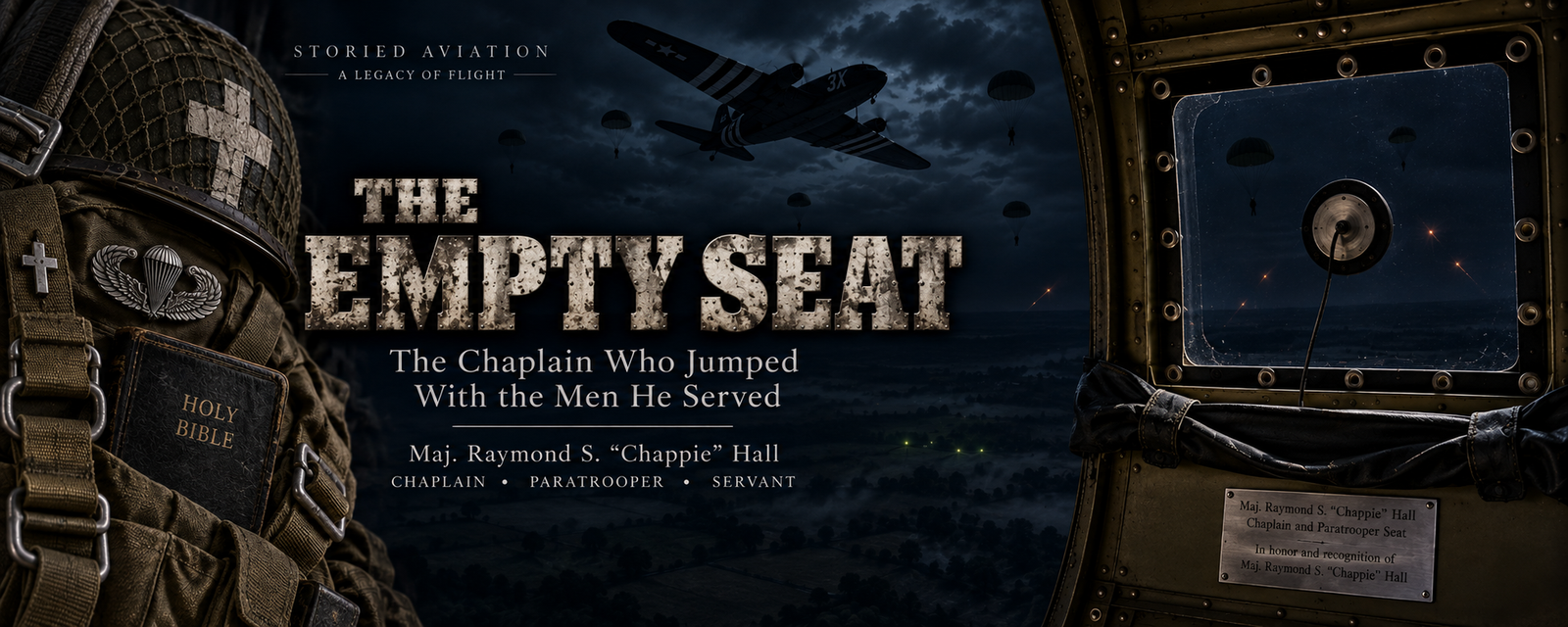
The header image for The Empty Seat is an AI-generated interpretive graphic created for Storied Aviation. It is not a historical photograph and does not depict a specific documented moment. Historical photographs and reference images were used to guide the representation of the aircraft interior, D-Day markings, airborne equipment and chaplain-related details.
The Bible and other equipment shown are representative and should not be understood as personal artifacts belonging to Chappie Hall. The nighttime airborne scene is an interpretive reconstruction intended to evoke the June 5–6, 1944 mission.